

Read the Dutch original ↗
This article was published in Dutch. The original text, with a German translation, opens in a new tab in the German section of this website.
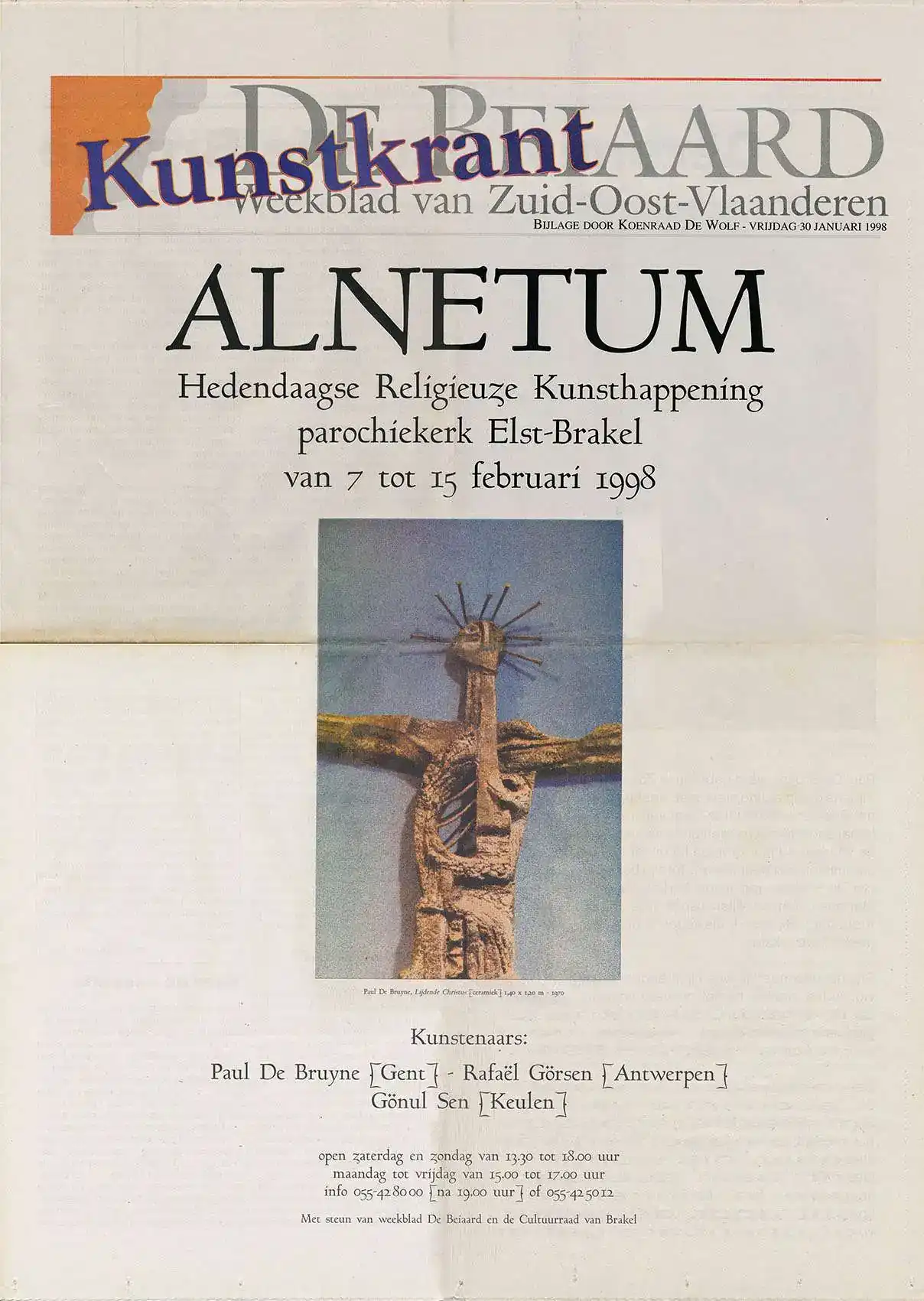
Alnetum 1998 – contemporary religious art event in the parish church of Elst-Brakel, February 7 to 15, 1998. Artists: Paul De Bruyne (Ghent), Rafaël Görsen (Antwerp), Gönül Sen (Cologne)
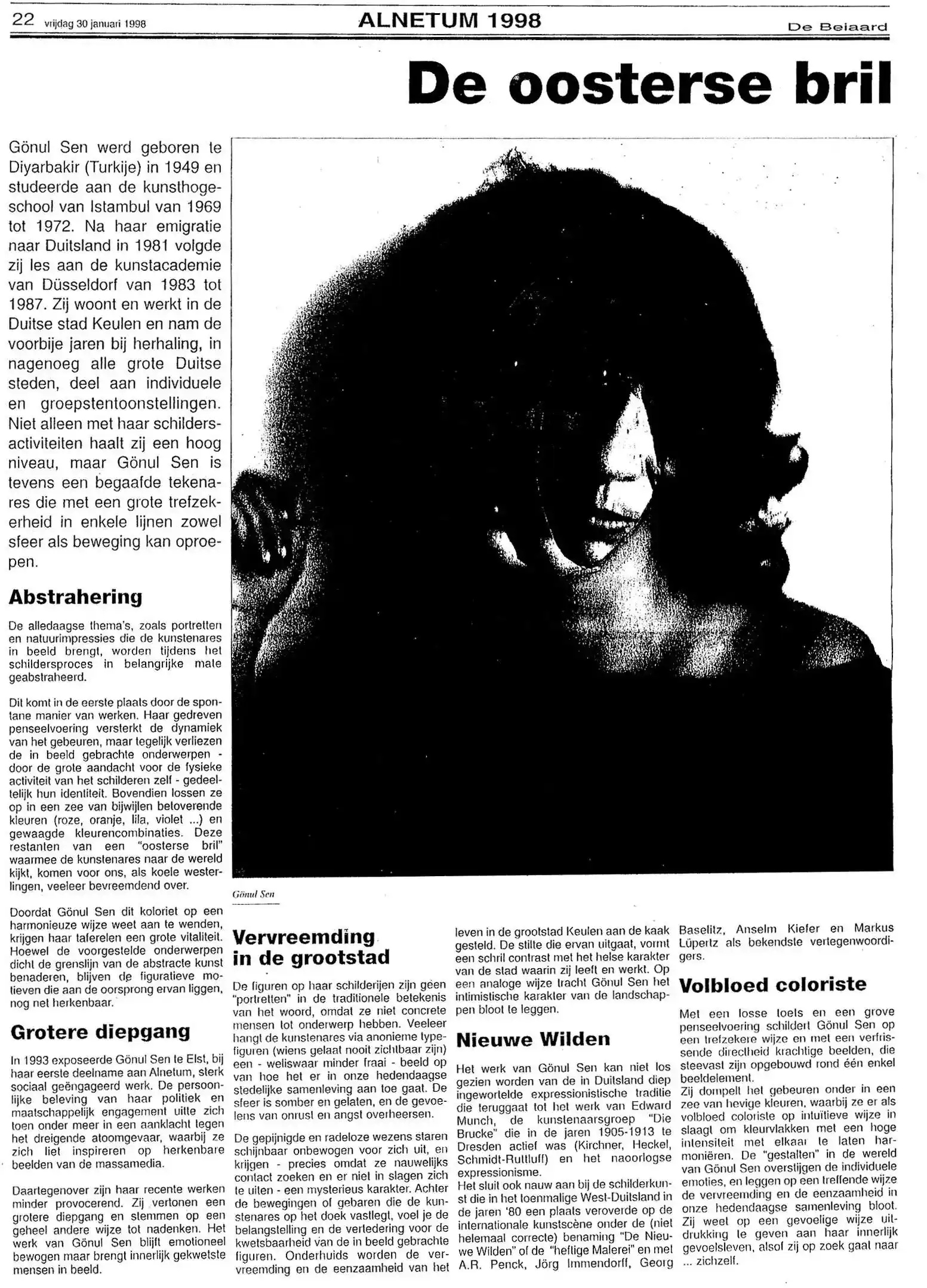
Gönül Sen was born in Diyarbakır (Turkey) in 1949 and studied at the art college in Istanbul from 1969 to 1972. After emigrating to Germany in 1981, she studied at the Düsseldorf Art Academy from 1983 to 1987. She lives and works in Cologne and in recent years has repeatedly taken part in solo and group exhibitions in almost all major German cities. She reaches a high level not only as a painter – Gönül Sen is also a gifted draftswoman who can evoke mood and movement with great precision in just a few lines.
Abstraction
The everyday subjects the artist depicts, such as portraits and impressions of nature, are abstracted to a high degree in the painting process.
This is mainly due to her spontaneous way of working. Her driven brushwork heightens the dynamism of what is happening; at the same time, the depicted motifs partly lose their identity – because of the great attention paid to the physical act of painting itself. They also dissolve in a sea of sometimes intoxicating colors (pink, orange, purple, violet …) and daring color combinations. These remnants of an “eastern lens” through which the artist looks at the world seem rather strange to us cool Western Europeans.
Because Gönül Sen knows how to use this palette harmoniously, her scenes gain great vitality. Even when the depicted motifs approach the border of abstract art, the figurative motifs underlying them remain just about recognizable.
Greater Depth
In 1993, at her first participation in Alnetum in Elst, Gönül Sen exhibited strongly socially engaged works. Her personal political and social commitment was expressed at the time in, among other things, an indictment of the looming nuclear threat, for which she drew inspiration from well-known images in the mass media.
Her newer works, by contrast, are less provocative. They have greater depth and prompt reflection in quite a different way. Gönül Sen’s work remains emotionally charged but shows people who are hurt inside.
Alienation in the Big City
The figures in her pictures are not “portraits” in the conventional sense, since they do not depict specific people. Rather, through anonymous type figures (whose faces are never visible), the artist paints a – if not very pretty – picture of what goes on in our urban society today. The mood is gloomy and resigned; feelings of unrest and fear predominate.
The tormented and bewildered beings seem to stare impassively ahead and – precisely because they hardly seek contact and cannot express themselves – take on something mysterious. Behind the movements and gestures the artist captures on canvas, one senses her sympathy and tenderness for the vulnerability of the depicted figures. Subliminally, the alienation and loneliness of life in the big city of Cologne are denounced. The silence emanating from the pictures stands in sharp contrast to the hellish character of the city in which she lives and works. In a similar way, Gönül Sen tries to lay bare the intimate character of landscapes.
Neue Wilde
Gönül Sen’s work cannot be separated from the expressionist tradition deeply rooted in Germany, which goes back to Edvard Munch, the artists’ group “Die Brücke” (active in Dresden 1905–1913: Kirchner, Heckel, Schmidt-Rottluff) and postwar Expressionism.
It is also closely linked to the painting that, in what was then West Germany, won a place on the international art scene in the 1980s under the (not entirely accurate) labels “Neue Wilde” or “Heftige Malerei” (violent painting) – with A. R. Penck, Jörg Immendorff, Georg Baselitz, Anselm Kiefer and Markus Lüpertz as its best-known representatives.
A Born Colorist
With a loose touch and coarse brushwork, Gönül Sen paints powerful pictures with precision and refreshing directness, always built around a single pictorial element.
She immerses the scene in a sea of vehement colors, and as a born colorist she intuitively manages to make color fields of high intensity harmonize with one another. The “figures” in Gönül Sen’s world transcend individual feelings and aptly expose the alienation and loneliness of our present-day society. She knows how to give sensitive expression to her inner emotional life – as if she were searching for … herself.
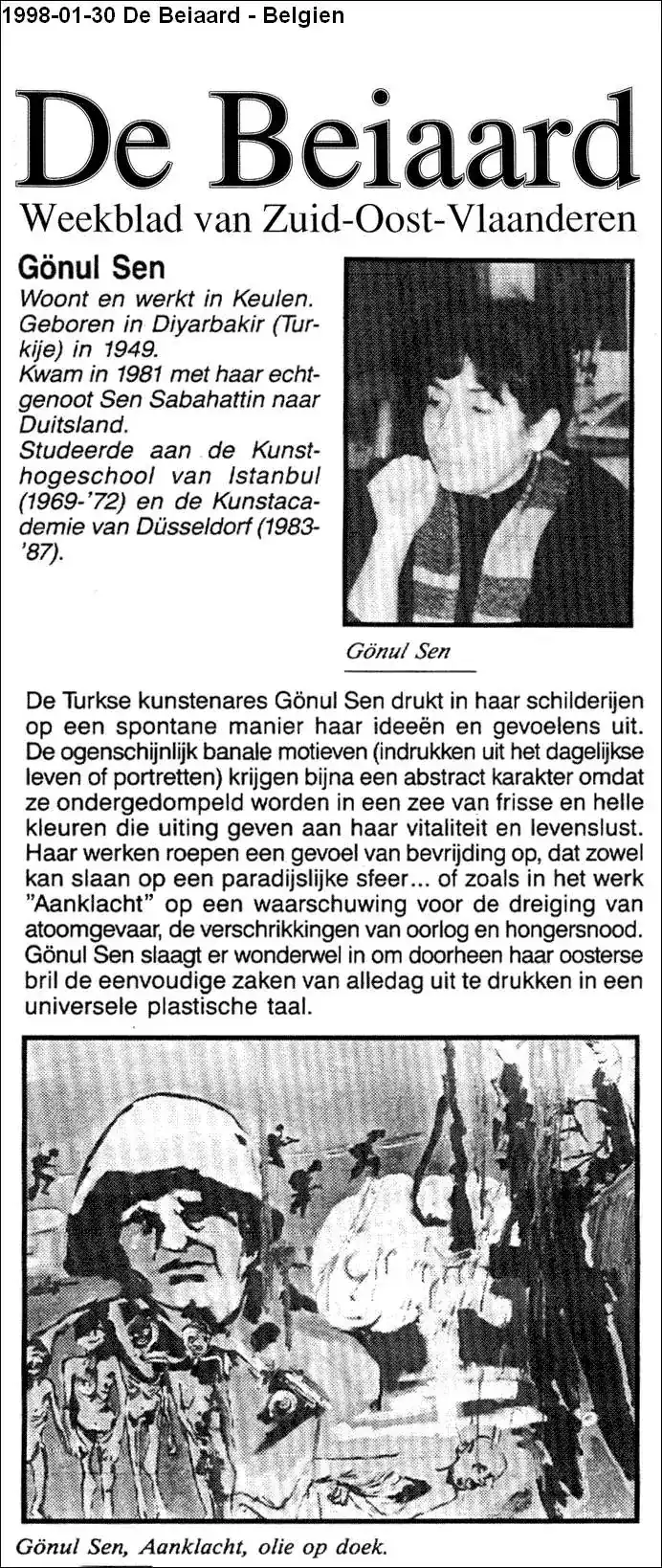
Gönül Sen (Short Introduction in De Beiaard)
Lives and works in Cologne. Born in Diyarbakır (Turkey) in 1949. Came to Germany in 1981 with her husband Sabahattin Sen. Studied at the art college in Istanbul (1969–72) and at the Düsseldorf Art Academy (1983–87).
The Turkish artist Gönül Sen spontaneously expresses her ideas and feelings in her pictures. The seemingly banal motifs (impressions of everyday life or portraits) take on an almost abstract character because they are immersed in a sea of fresh, bright colors that express her vitality and joie de vivre. Her works evoke a feeling of liberation, which may refer to a paradisiacal atmosphere … or, as in the work “Indictment”, to a warning of nuclear danger and the horrors of war and famine. Through her eastern lens, Gönül Sen wonderfully manages to express the simple things of everyday life in a universal pictorial language.
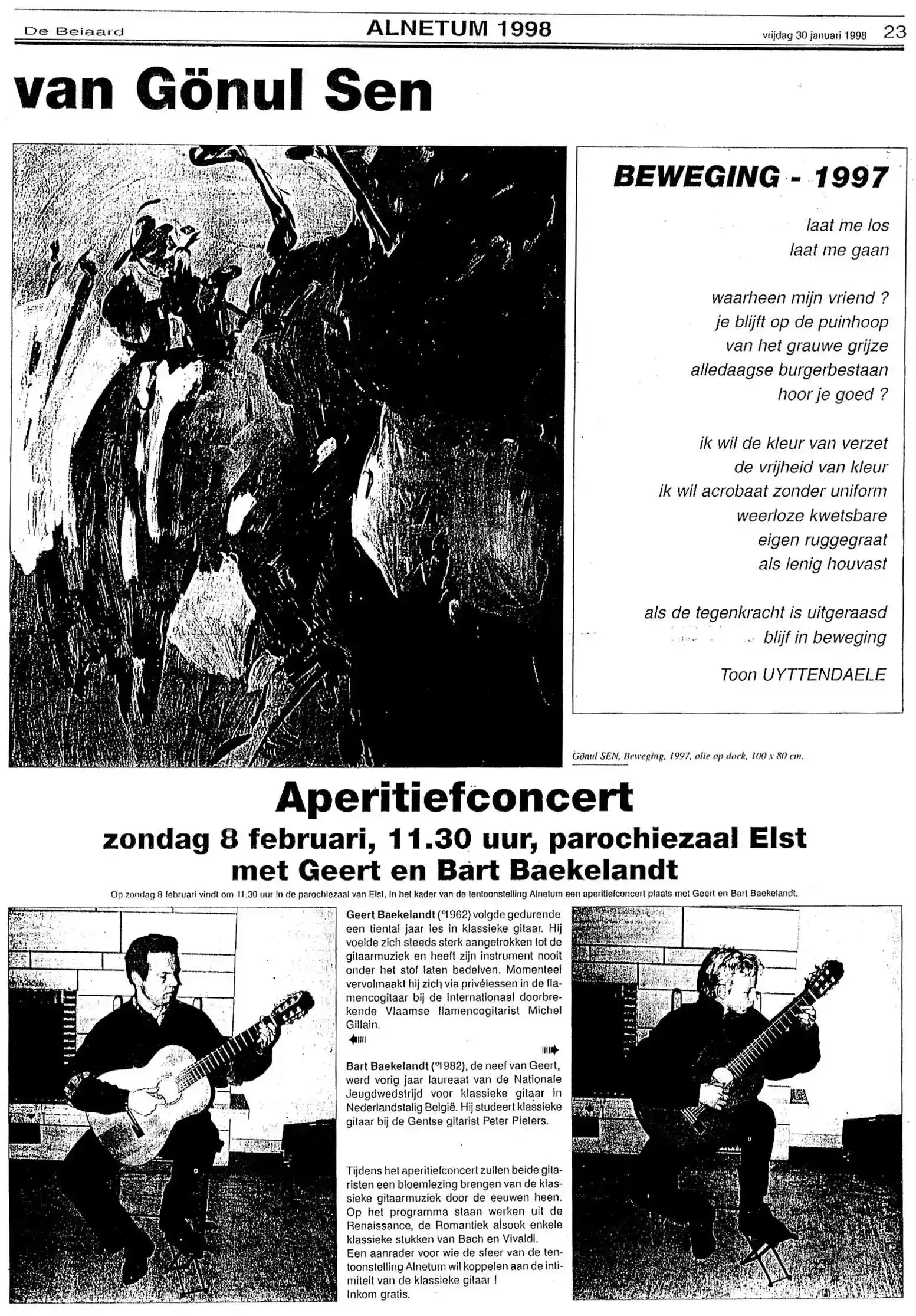
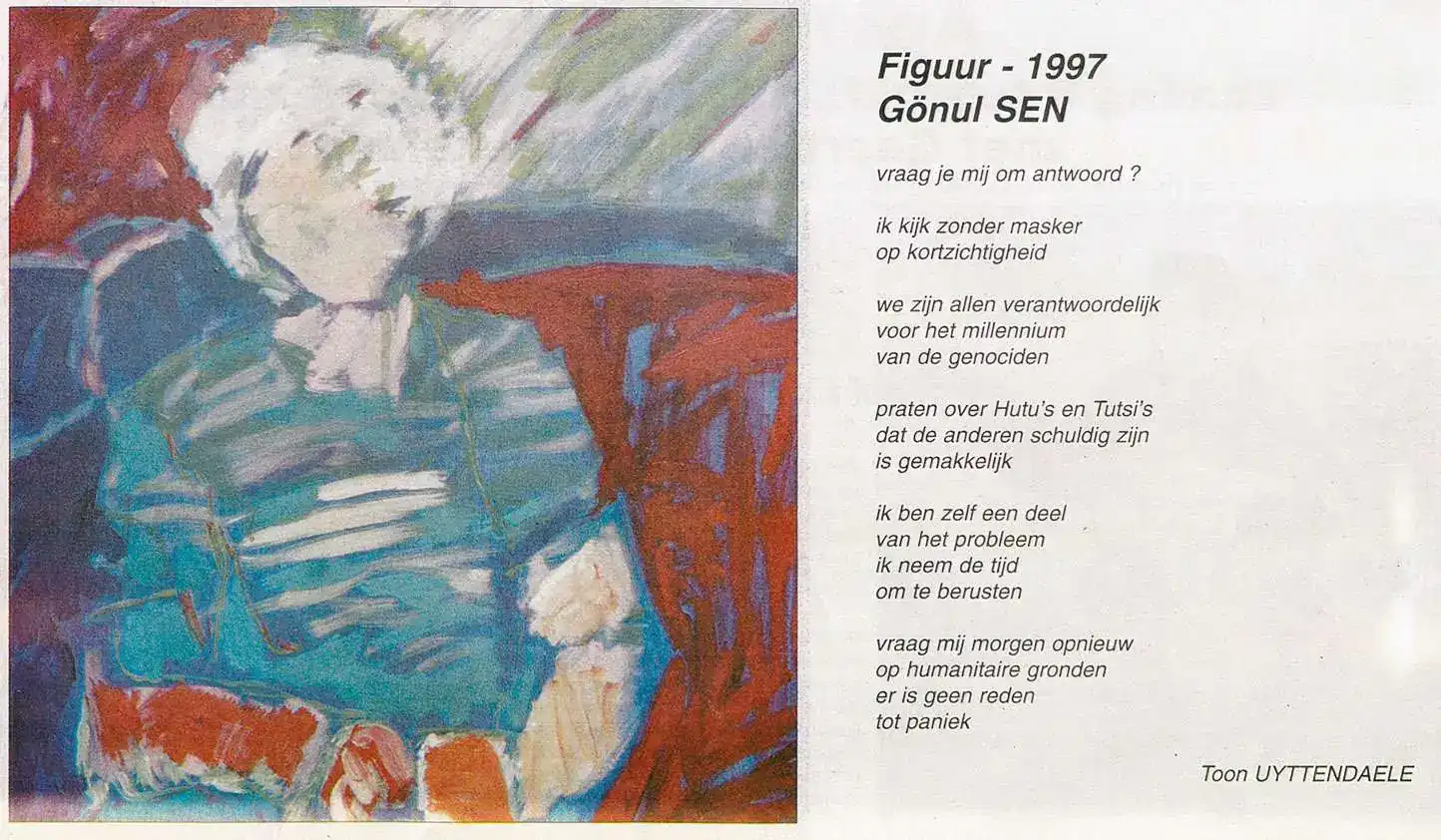
The article appeared in the Kunstkrant, a supplement by Koenraad De Wolf to De Beiaard, Weekblad van Zuid-Oost-Vlaanderen (Belgium), January 30, 1998, pp. 22–23, on the occasion of the Alnetum 1998 exhibition in Elst-Brakel. The illustrations also show Gönül Sen’s paintings “Beweging” (1997) and “Figuur” (1997) with poems by Toon Uyttendaele (only in the scan). Translated from Dutch for senmenzel.com.
About the Exhibition
Exhibition 1998: Alnetum, Belgium – listed in the overview Exhibitions of Gönül Sen-Menzel.


