

Read the Turkish original ↗
This article was published in Turkish. The original text, with a German translation, opens in a new tab in the German section of this website.
After the joint exhibition in Essen, we spoke with the painters
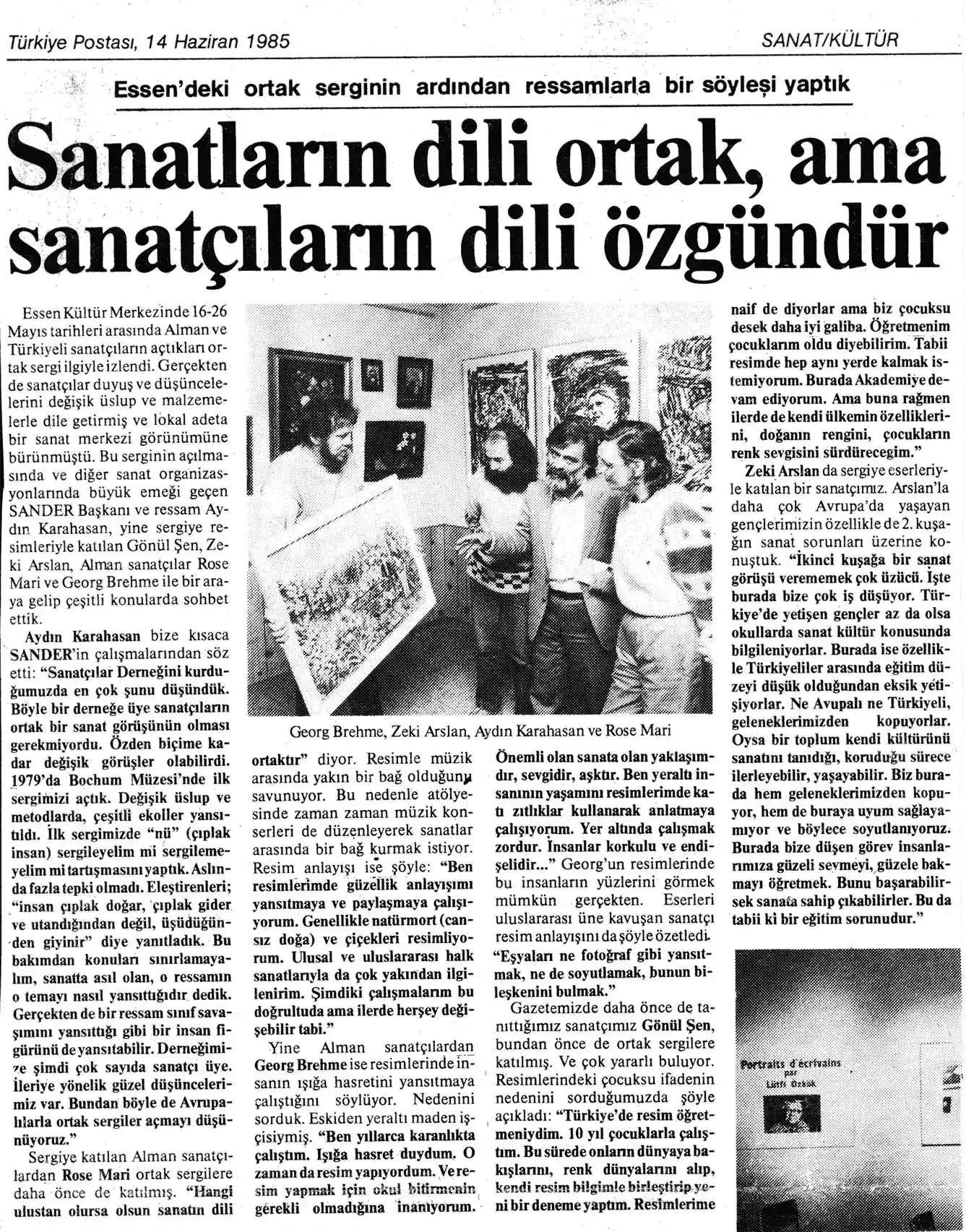
The joint exhibition of German and Turkish artists at the Essen cultural center from May 16 to 26 met with great interest. The artists had expressed their feelings and thoughts in different styles and materials, and the space had virtually turned into an art center. We met the chairman of SANDER, the painter Aydın Karahasan, who has done a great deal for this exhibition and other art projects, as well as Gönül Şen and Zeki Arslan, who were also represented with pictures, and the German artists Rose Mari and Georg Brehme, for a conversation on various topics.
Aydın Karahasan briefly told us about SANDER’s work: “When we founded the artists’ association, one thing above all was important to us: the members of such an association did not need to share a common view of art. From content to form, there could be very different opinions. In 1979 we opened our first exhibition at the Bochum Museum. It showed different styles and methods, different schools. At our first exhibition we discussed whether or not to show nudes. There were hardly any protests, in fact. We answered the critics: ‘Man comes into the world naked, leaves it naked, and dresses not out of shame but because he is cold.’ So we said: let’s not restrict the subjects – in art, what matters is how a painter treats a subject. A painter can depict the class struggle just as well as a human figure. Many artists belong to our association today. We have fine plans for the future and want to continue organizing joint exhibitions with Europeans.”
The German artist Rose Mari has taken part in joint exhibitions before. “Whatever the nation – the language of art is shared,” she says. She is convinced that painting and music are closely connected. That is why she occasionally holds concerts in her studio, to build a bridge between the arts. Of her view of art she says: “In my pictures I try to express and share my idea of beauty. I mostly paint still lifes and flowers. I am also very interested in national and international folk art. My current works go in that direction – but in the future, of course, everything can change.”
The German artist Georg Brehme says he tries to depict people’s longing for light in his pictures. We asked why: he used to be a miner underground. “For years I worked in the dark. I longed for light. Even then I painted. And I don’t believe you need to have finished a school to paint. What matters is your attitude toward art, the love, the passion. In my pictures I try to tell the story of the people underground with hard contrasts. Working underground is hard. People are afraid and worried …” In Georg’s pictures you can indeed see the faces of these people. The internationally known artist summed up his view of art like this: “Neither depict things photographically nor abstract them, but find the connection between the two.”
Our artist Gönül Şen, whom we have already introduced in our newspaper, has taken part in joint exhibitions before and considers them very useful. Asked about the childlike expression in her pictures, she explained: “In Turkey I was an art teacher. For ten years I worked with children. During that time I absorbed their view of the world and their world of color, combined it with my own painterly knowledge and tried something new. My pictures are also called naive, but ‘childlike’ probably fits better. I can say: my children became my teachers. Of course I don’t want to stay in the same place in painting. Here I continue to attend the academy. Nevertheless, I will continue to carry forward the special features of my country, the colors of nature and children’s love of color.”
Zeki Arslan is also one of our artists taking part in the exhibition with works. With him we talked mainly about the artistic problems of our young people living in Europe, especially the second generation. “It is very sad that we cannot pass on an understanding of art to the second generation. We have a lot to do here. Young people growing up in Turkey at least learn something about art and culture at school. Here, by contrast – precisely because the level of education among people of Turkish origin is low – they grow up with gaps. They are neither Europeans nor Turks and lose touch with our traditions. Yet a society can only progress and stay alive as long as it knows and cultivates its culture and art. Here we lose touch with our traditions but cannot adapt either, and so we isolate ourselves. Our task is to teach our people to love beauty and to look at beauty. If we succeed, they can embrace art. That is, of course, a question of education.”
Caption: Georg Brehme, Zeki Arslan, Aydın Karahasan and Rose Mari
The interview appeared in the weekly newspaper Türkiye Postası on June 14, 1985 (“Sanat/Kültür” section). The section about Gönül Şen is highlighted. Translated from Turkish for senmenzel.com.
More Articles from Türkiye Postası
- “Gönül Şen’s Painting Exhibition” · Exhibition Report
- “The Colors of Anatolia Reflected in Gönül Sen’s Paintings” · Portrait


