

By J. Schön
Read the German original ↗
This article was published in German. The original text opens in a new tab in the German section of this website.
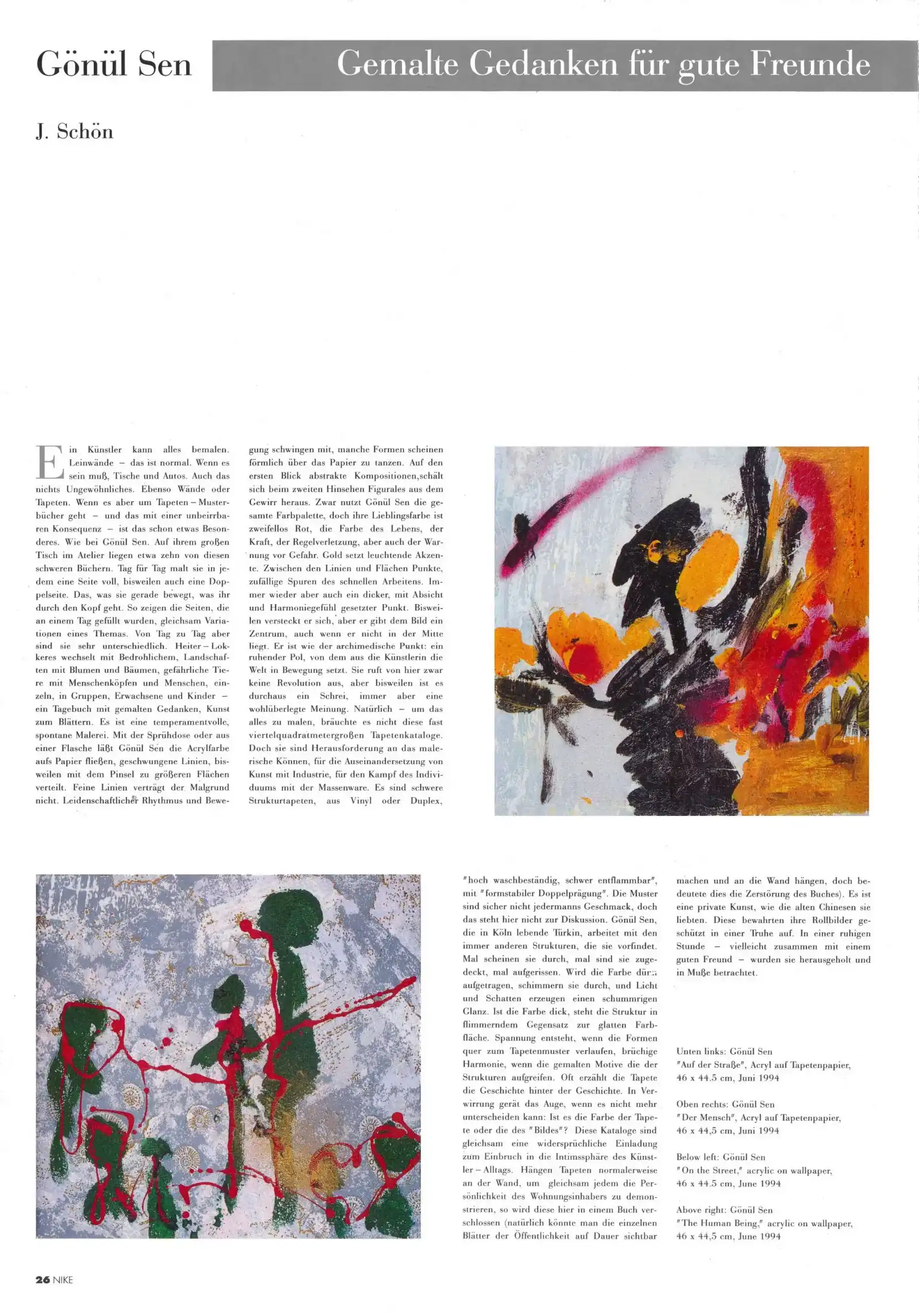
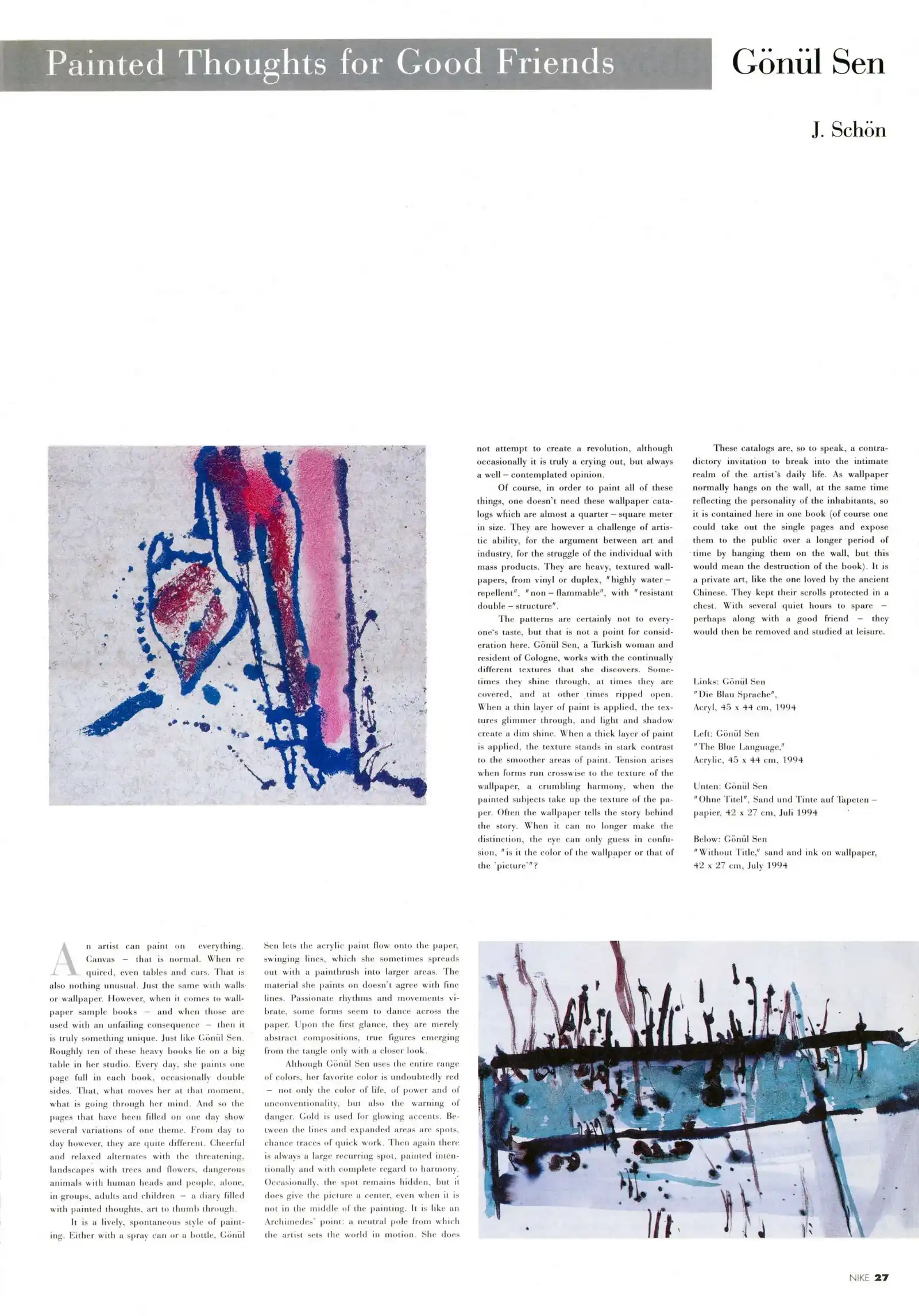
An artist can paint on anything. Canvases – that’s normal. If need be, tables and cars. Nothing unusual about that either. Walls or wallpaper, too.
But when it comes to wallpaper sample books – and with unwavering consistency – that is something special. As with Gönül Sen. On the large table in her studio lie about ten of these heavy books. Day after day she fills a page in each, sometimes a double page. Whatever is moving her at the moment, whatever is going through her head. So the pages filled on one day show variations on a theme, as it were. But from day to day they are very different. Cheerful, relaxed pages alternate with threatening ones; landscapes with flowers and trees, dangerous animals with human heads and people, alone, in groups, adults and children – a diary of painted thoughts, art to leaf through. It is temperamental, spontaneous painting. Gönül Sen lets the acrylic paint flow onto the paper from a spray can or a bottle, in curving lines, sometimes spread into larger areas with a brush. The surface does not tolerate fine lines.
Passionate rhythm and movement resonate; some forms seem literally to dance across the paper. At first glance abstract compositions, on second look figurative elements emerge from the tangle. Gönül Sen uses the entire color palette, but her favorite color is undoubtedly red, the color of life, of strength, of breaking the rules, but also of warning of danger. Gold sets luminous accents. Between the lines and surfaces there are dots, random traces of fast work. But again and again there is also a thick dot set with intention and a sense of harmony. Sometimes it hides, but it gives the picture a center, even if it is not in the middle. It is like the Archimedean point: a calm pole from which the artist sets the world in motion. She does not proclaim a revolution from here, but at times it is certainly a scream – always, though, a well-considered opinion.
Of course, you wouldn’t need these wallpaper catalogs, almost a quarter of a square meter in size, to paint all this. But they are a challenge to painterly skill, to art’s confrontation with industry, to the individual’s struggle with mass-produced goods. They are heavy textured wallpapers, made of vinyl or duplex, “highly washable, flame-retardant”, with “dimensionally stable double embossing”. The patterns are surely not to everyone’s taste, but that is not up for discussion here. Gönül Sen, a Turkish woman living in Cologne, works with the ever-different textures she finds. Sometimes they show through, sometimes they are covered, sometimes torn open. When the paint is applied thinly, they shimmer through, and light and shadow create a dim sheen. When the paint is thick, the texture stands in flickering contrast to the smooth surface of color. Tension arises when the forms run across the wallpaper pattern; a fragile harmony when the painted motifs take up those of the textures. Often the wallpaper tells the story behind the story. The eye becomes confused when it can no longer tell: is it the color of the wallpaper or that of the “picture”?
These catalogs are, as it were, a contradictory invitation to break into the intimate sphere of the artist’s everyday life. Whereas wallpaper normally hangs on the wall to show everyone the personality of the occupant, here it is locked up in a book (of course one could make the individual sheets permanently visible to the public and hang them on the wall, but that would mean destroying the book). It is a private art, as the ancient Chinese loved it. They kept their scroll paintings protected in a chest. In a quiet hour – perhaps together with a good friend – they were taken out and contemplated at leisure.
Illustrations in the original: Gönül Sen, “On the Street”, acrylic on wallpaper, 46 × 44.5 cm, June 1994 – Gönül Sen, “The Human Being”, acrylic on wallpaper, 46 × 44.5 cm, June 1994.
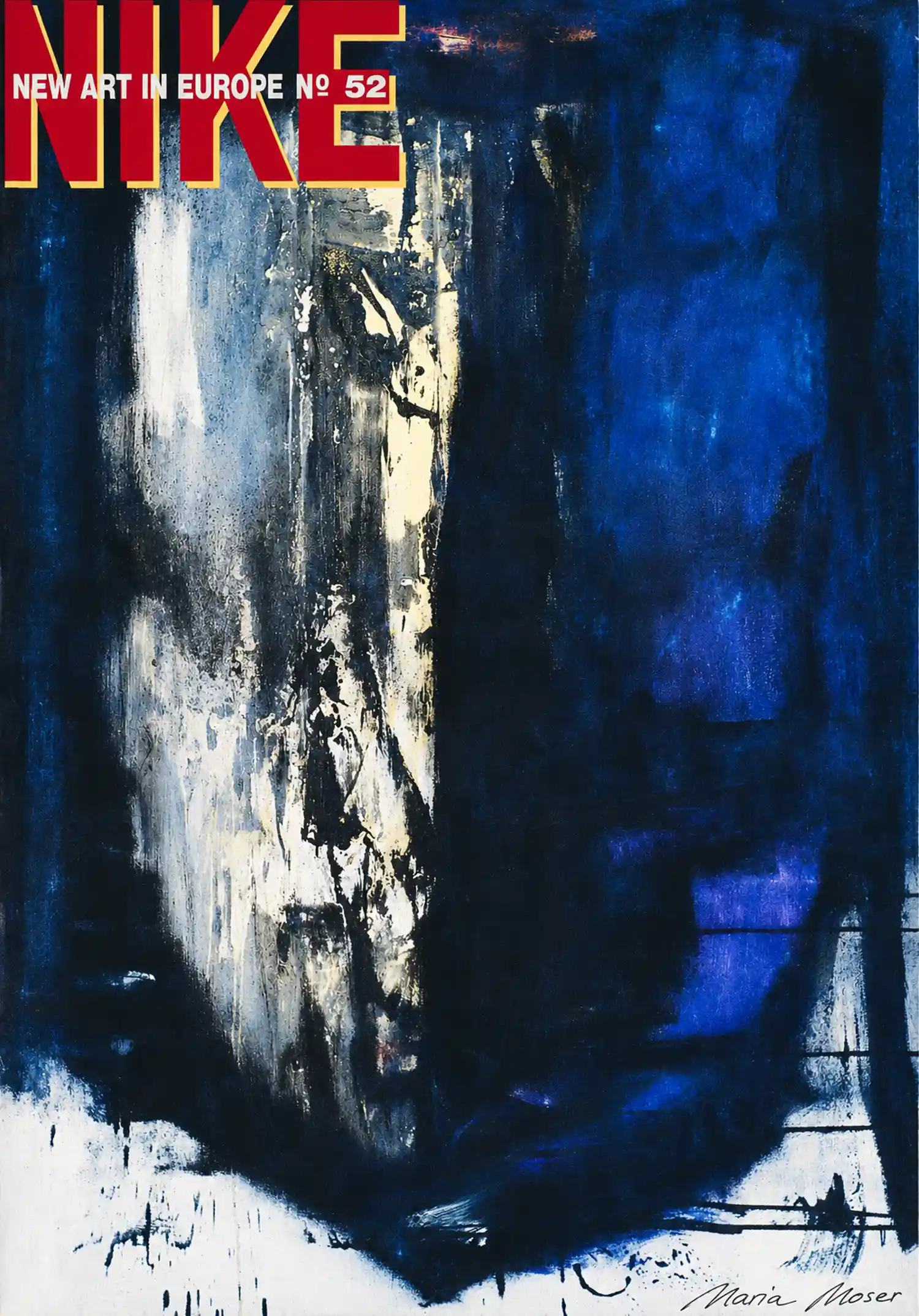
The article appeared in NIKE – New Art in Europe, No. 52, in German and English; the English version and the cover are shown below the original article.


