

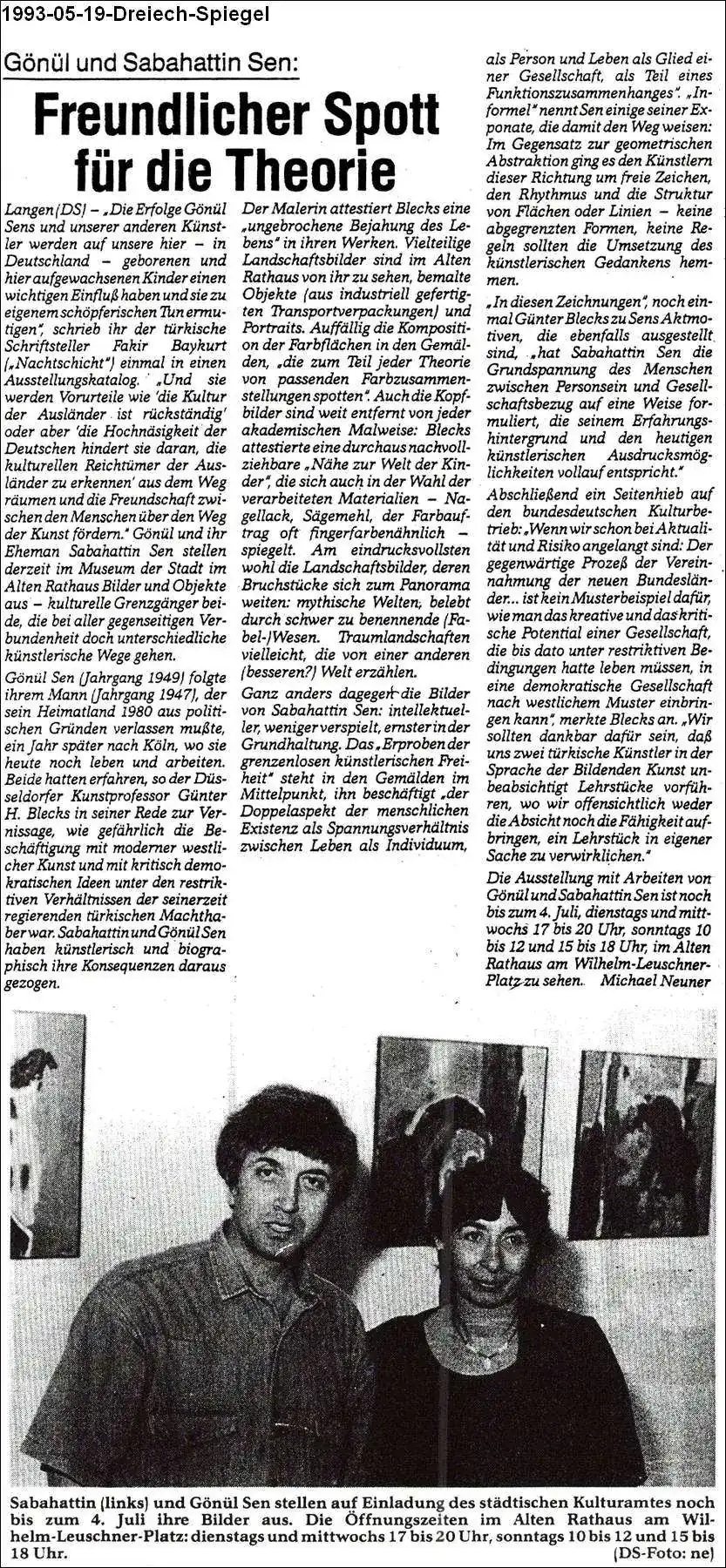
Gönül and Sabahattin Sen at the Old Town Hall in Langen
By Michael Neuner
Read the German original ↗
This article was published in German. The original text opens in a new tab in the German section of this website.
Langen. “The successes of Gönül Sen and our other artists will have an important influence on our children born and raised here – in Germany – and encourage them to be creative themselves,” the Turkish writer Fakir Baykurt (“Night Shift”) once wrote about her in an exhibition catalog.
“And they will clear away prejudices such as ‘the culture of foreigners is backward’ or ‘the arrogance of the Germans prevents them from recognizing the cultural riches of foreigners’, and promote friendship between people by way of art.” Gönül and her husband Sabahattin Sen are currently exhibiting pictures and objects at the city museum in the Old Town Hall – both cultural border-crossers who, for all their mutual attachment, follow different artistic paths. Gönül Sen (born 1949) followed her husband (born 1947), who had to leave his home country for political reasons in 1980, to Cologne a year later, where they still live and work today. Both had experienced, as the Düsseldorf art professor Günter H. Blecks said in his speech at the opening, how dangerous it was to engage with modern Western art and with critical democratic ideas under the restrictive conditions of the Turkish rulers of the time. Sabahattin and Gönül Sen drew the artistic and biographical consequences.
Blecks attests to the painter an “unbroken affirmation of life” in her works. Multi-part landscapes by her can be seen at the Old Town Hall, as well as painted objects (made from industrially manufactured transport packaging) and portraits. Striking is the composition of color fields in the paintings, “some of which mock every theory of matching color combinations”. The head pictures, too, are far removed from any academic style: Blecks noted a quite understandable “closeness to the world of children”, which is also reflected in the choice of materials – nail polish, sawdust, the paint often applied like finger paint. Most impressive are probably the landscapes, whose fragments widen into a panorama: mythical worlds, populated by hard-to-name (fabulous) creatures. Dream landscapes, perhaps, telling of another (better?) world.
Quite different are Sabahattin Sen’s pictures: more intellectual, less playful, more serious in their basic attitude. The paintings focus on “testing boundless artistic freedom”; he is concerned with “the dual aspect of human existence as a tension between life as an individual, as a person, and life as a member of a society, as part of a functional context”. Sen calls some of his exhibits “Informel”, which points the way: in contrast to geometric abstraction, artists of this movement were concerned with free signs, the rhythm and structure of surfaces or lines – no delimited forms, no rules were to hinder the realization of the artistic idea.
“In these drawings,” Günter Blecks said again of Sen’s nude motifs, which are also on display, “Sabahattin Sen has formulated the basic tension of the human being between being a person and relating to society in a way that fully corresponds to his background of experience and today’s means of artistic expression.” Finally, a dig at the German cultural establishment: “Since we have arrived at topicality and risk: the current process of absorbing the new federal states … is not a model of how to bring the creative and critical potential of a society that had to live under restrictive conditions until now into a democratic society on the Western model,” Blecks remarked. “We should be grateful that two Turkish artists unintentionally present us with object lessons in the language of the visual arts, where we evidently have neither the intention nor the ability to produce an object lesson in our own affairs.”
The exhibition of works by Gönül and Sabahattin Sen can be seen at the Old Town Hall on Wilhelm-Leuschner-Platz until July 4, Tuesdays and Wednesdays 5 to 8 p.m., Sundays 10 a.m. to 12 noon and 3 to 6 p.m.
Original caption: At the invitation of the municipal Cultural Office, Sabahattin (left) and Gönül Sen are exhibiting their pictures until July 4.
About the Exhibition
Exhibition 1993: Langen City Museum – listed in the overview Exhibitions of Gönül Sen-Menzel.
More press coverage of this exhibition:
- “Art in the Old Town Hall: Paintings by Gönül Sen and Sabahattin Sen” · Invitation · Langen City Museum


