

By Osman Çutsay
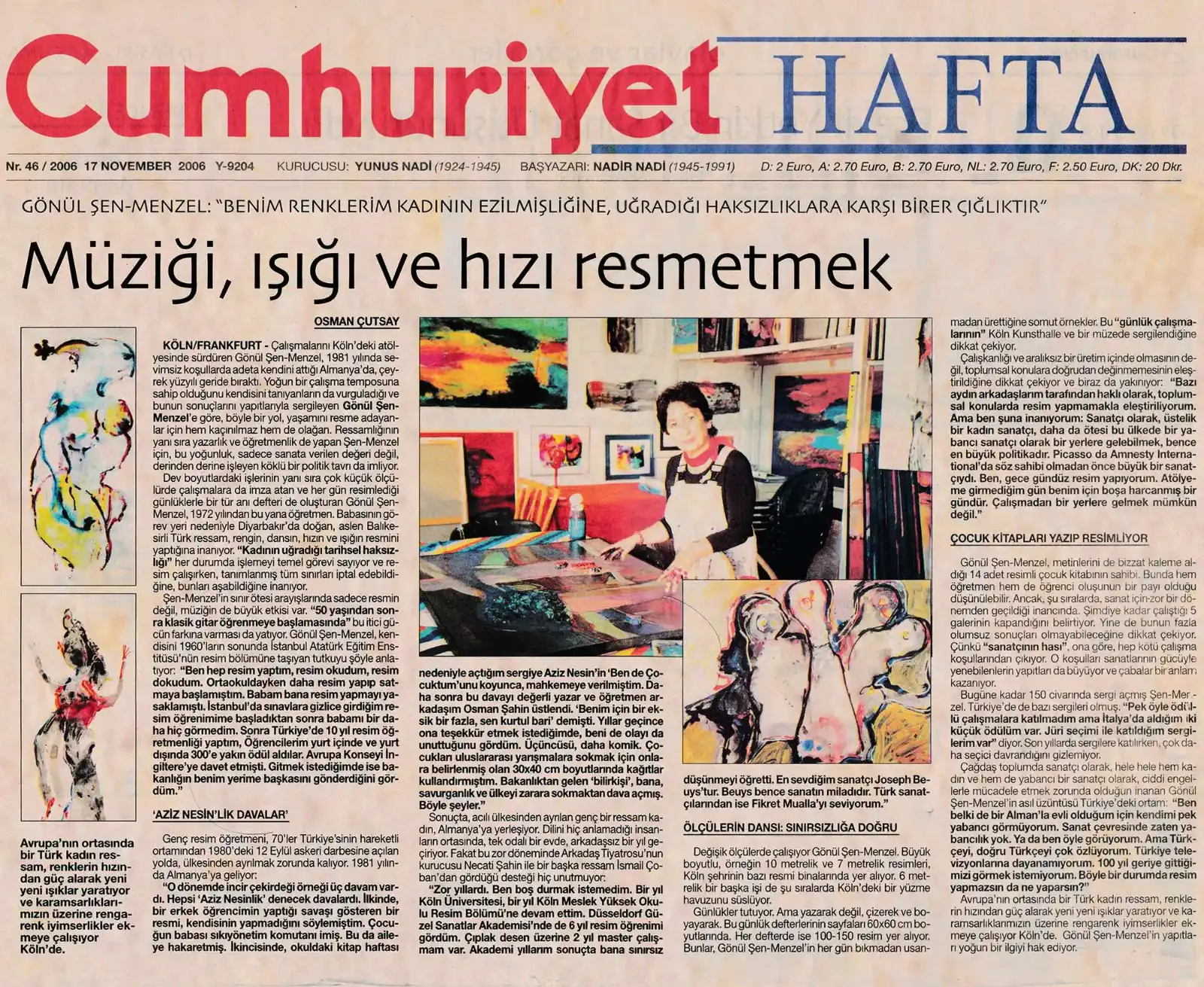
Read the Turkish original ↗
This article was published in Turkish. The original text, with a German translation, opens in a new tab in the German section of this website.
Gönül Şen-Menzel: “My colors are a scream against the oppression of women and the injustice done to them”
Cologne/Frankfurt – Gönül Şen-Menzel, who works in her Cologne studio, has now lived for a quarter of a century in Germany, where she virtually threw herself in 1981 under less than happy circumstances. Those who know her stress her intense pace of work, the results of which she shows in her works. For Gönül Şen-Menzel, such a path is as inevitable as it is natural for someone who devotes their life to painting. For Şen-Menzel, who writes and teaches as well as paints, this intensity stands not only for the value she places on art but also for a deeply rooted political stance.
Besides huge works, Gönül Şen-Menzel also creates very small-format works and keeps a kind of memory book in the form of diaries painted daily. She has been a teacher since 1972. The Turkish painter, who was born in Diyarbakır because of her father’s posting and actually comes from Balıkesir, is convinced that she paints color, dance, speed and light. She regards dealing with “the historical injustice that women suffer” in every situation as her fundamental task, and she believes that when painting she can lift and cross all fixed boundaries.
Not only painting but also music plays a major role in Şen-Menzel’s search beyond boundaries. The fact that she “began learning classical guitar after the age of 50” also has to do with her recognizing this driving force. Gönül Şen-Menzel talks about the passion that brought her to the art department of the Atatürk Education Institute in Istanbul in the late 1960s: “I have always painted, studied painting, woven painting. I started painting and selling pictures in middle school. My father had forbidden me to paint. After I secretly took the entrance exams in Istanbul and started my art studies, I never saw my father again. After that I was an art teacher in Turkey for ten years. My pupils won almost 300 prizes at home and abroad. The Council of Europe had invited me to England. When I wanted to go, I found that the ministry had sent someone else in my place.”
Trials “Like Aziz Nesin’s”
On the path from the turbulent climate of Turkey in the 1970s to the military coup of September 12, 1980, the young art teacher had to leave her country. In 1981 she came to Germany:
“At the time I had three ridiculous court cases hanging over me. All cases you could call ‘like Aziz Nesin’s’. In the first, I had said that a picture showing a war had not been painted by my pupil himself. The boy’s father was apparently a martial law commander – that was considered an insult to the family. In the second, I was charged because I had included Aziz Nesin’s ‘Ben de Çocuktum’ (‘I Was a Child Too’) in an exhibition for book week at the school. This case was later taken over by my esteemed friend, the writer and teacher Osman Şahin. ‘One more or less doesn’t matter for me – at least save yourself,’ he had said. When I wanted to thank him years later, I realized he had forgotten me and the whole matter. The third case was even more comical. So that the children could take part in international competitions, I had let them use the prescribed paper size of 30 x 40 cm. The ministry’s ‘expert’ sued me for waste and damaging the state. Things like that.”
And so a young painter who had left her long-suffering country settled in Germany. For a year she lived among people whose language she did not understand at all, without friends, in a one-room apartment. She never forgets the support she received in this difficult time from Necati Şahin, founder of the Arkadaş Theater, and the painter İsmail Çoban:
“They were hard years. I didn’t want to be idle. I attended the University of Cologne for a year, and the painting department of the Cologne University of Applied Sciences for a year. Then I studied painting at the Düsseldorf Art Academy for six years, two of them as postgraduate studies in life drawing. The years at the academy taught me to think without limits. My favorite artist is Joseph Beuys. For me, Beuys is the zero point of art. Of the Turkish artists, I love Fikret Mualla.”
A Dance of Formats: Into the Boundless
Gönül Şen-Menzel works in very different formats. Large-format pictures, for example 10 and 7 meters long, hang in some public buildings of the City of Cologne. Another work, six meters long, currently adorns a Cologne swimming pool.
She keeps diaries – not by writing, but by drawing and painting. The pages of these diary books measure 60 x 60 cm, and each book contains 100 to 150 pictures. They are concrete examples of what Gönül Şen-Menzel tirelessly creates day after day. She points out that these “daily works” have been exhibited at the Kunsthalle Köln and in a museum.
She notes that people do not criticize her diligence and unceasing production, but rather the fact that she does not directly address social issues – and complains a little: “Some of my intellectual friends rightly criticize me for not painting pictures on social issues. But I believe this: as an artist – and a woman, and moreover a foreign artist in this country – achieving something is the greatest politics for me. Picasso, too, was a great artist before he had anything to say at Amnesty International. I paint day and night. A day on which I don’t go to my studio is a lost day for me. Without work, you get nowhere.”
She Writes and Illustrates Children’s Books
Gönül Şen-Menzel has published 14 illustrated children’s books whose texts she wrote herself. One can assume that both the teacher and the learner in her play a role in this. She is convinced, however, that art is currently going through a difficult time. Five galleries she worked with have closed. Yet this need not have overly negative consequences. For, in her opinion, “what is genuine in the artist” always arises from poor working conditions. The works of those who overcome these conditions through the power of their art grow, and the efforts take on meaning.
Şen-Menzel has held around 150 exhibitions to date, some of them in Turkey. “I haven’t taken part in many prize competitions, but I received two small prizes in Italy. And I have had juried exhibitions,” she says. She does not hide the fact that she has become much more selective about taking part in exhibitions in recent years.
Gönül Şen-Menzel is convinced that in today’s society one has to assert oneself as an artist – especially as a woman and a foreigner – against considerable obstacles. Her real sorrow, however, is the situation in Turkey: “Perhaps because I am married to a German, I don’t feel particularly foreign. In the art scene there is no foreignness anyway. Or that is how I see it. But I miss Turkish – real Turkish – very much. I can’t stand Turkish television. I don’t want to watch us go back a hundred years. What else can you do in such a situation but paint?”
In the middle of Europe, in Cologne, a Turkish painter draws strength from the speed of colors, creates ever new lights and tries to sow colorful optimism over our pessimism. The works of Gönül Şen-Menzel deserve great attention.
The portrait appeared in the weekly supplement Cumhuriyet Hafta, No. 46/2006, November 17, 2006. Translated from Turkish for senmenzel.com.
More Articles from Cumhuriyet
- “Gönül Şen Sevimtaş Exhibition” · Exhibition Notice
- “Gönül Şen Painting Exhibition” · Exhibition Notice


