

Opening speech for the exhibition of the painter Gönül Şen at Cologne City Hall on December 19, 1987
By Necati Şahin
Read the German original ↗
This article was published in German. The original text opens in a new tab in the German section of this website.
Dear friends,
Making and looking at art is more beautiful than talking about art. Still, it is more pleasant to talk about art and artists than about other subjects. Allow me to tell you a few things about Gönül and to share some general thoughts:
I met Gönül six years ago in her 25 m² “apartment” – a Cologne basement without windows. She lived there with her husband, Sabahattin Şen – a painter like her – and their little son. She was ill. The first time I saw her, she was painting on her bed. Because there was so little light and space, the two of them could not paint at the same time. So each time she had to gather up her materials and push them under the bed so that he had enough room to paint.
At that time we, the Turkish Teachers’ Association, also had small premises – also a Cologne basement. It was, however, somewhat larger than Gönül’s.
But neither we nor Gönül were pessimistic: we did not complain but made the best of the situation. We exhibited the pictures painted in Gönül’s Cologne basement in another, somewhat larger Cologne basement – namely our premises.
The Aliens Office, the Health Office, the Social Welfare Office, the Housing Office and the Employment Office are important milestones for every one of us. On her way, Gönül also found the Cultural Office, the School Office and the “Study Office”. And so she was finally able to begin her studies at the Düsseldorf Art Academy with Prof. Schiff, who is also here with us today.
Gönül now has a somewhat larger apartment; she no longer has to live and work in a basement. Incidentally, we too have larger premises today – though still in a basement!!
In this context, our thanks go to the City of Cologne for the fact that Gönül now also has a small studio.
Ladies and gentlemen,
my remarks about Gönül’s living conditions in Germany are not meant to arouse your pity. Gönül does not need pity!
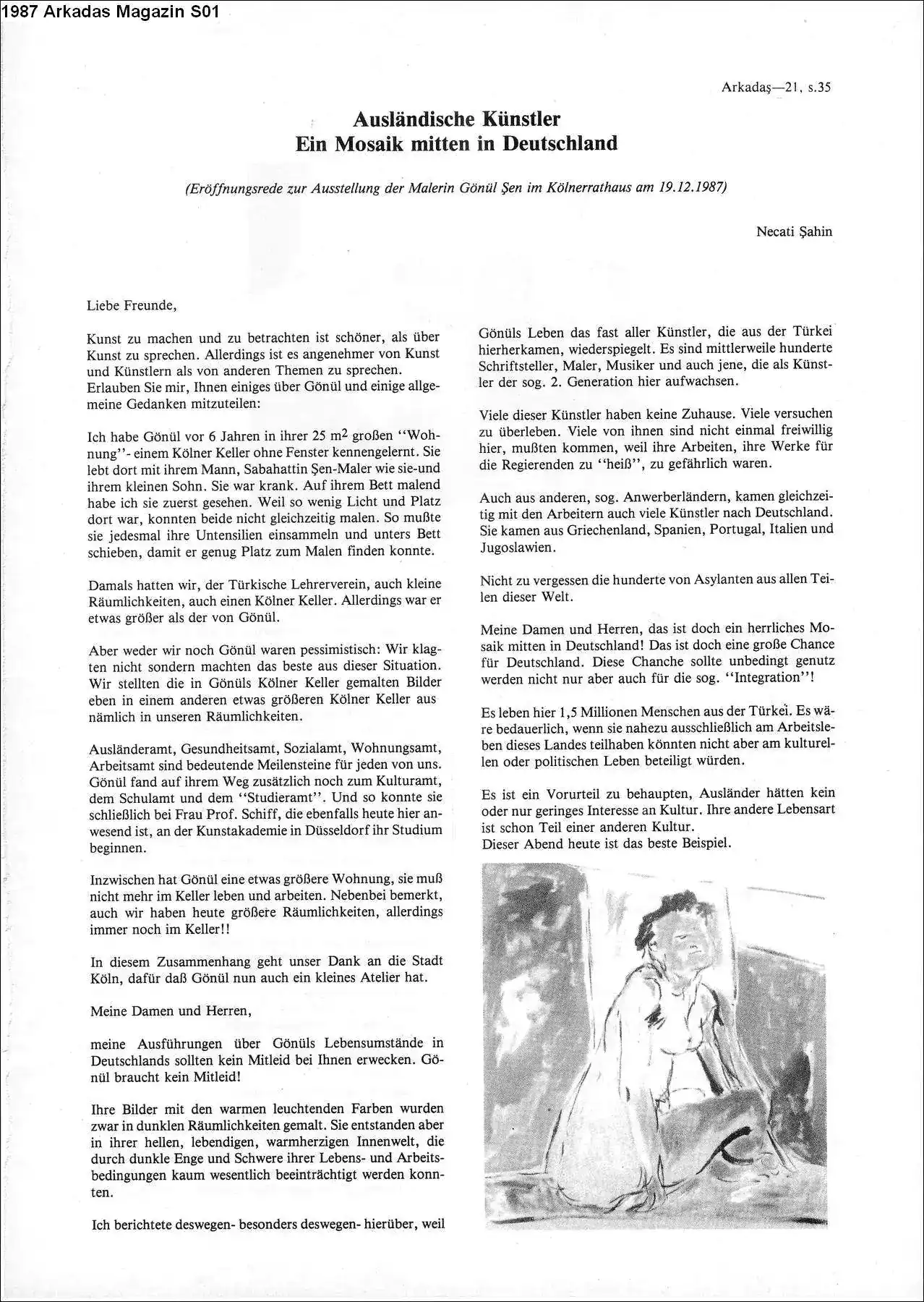
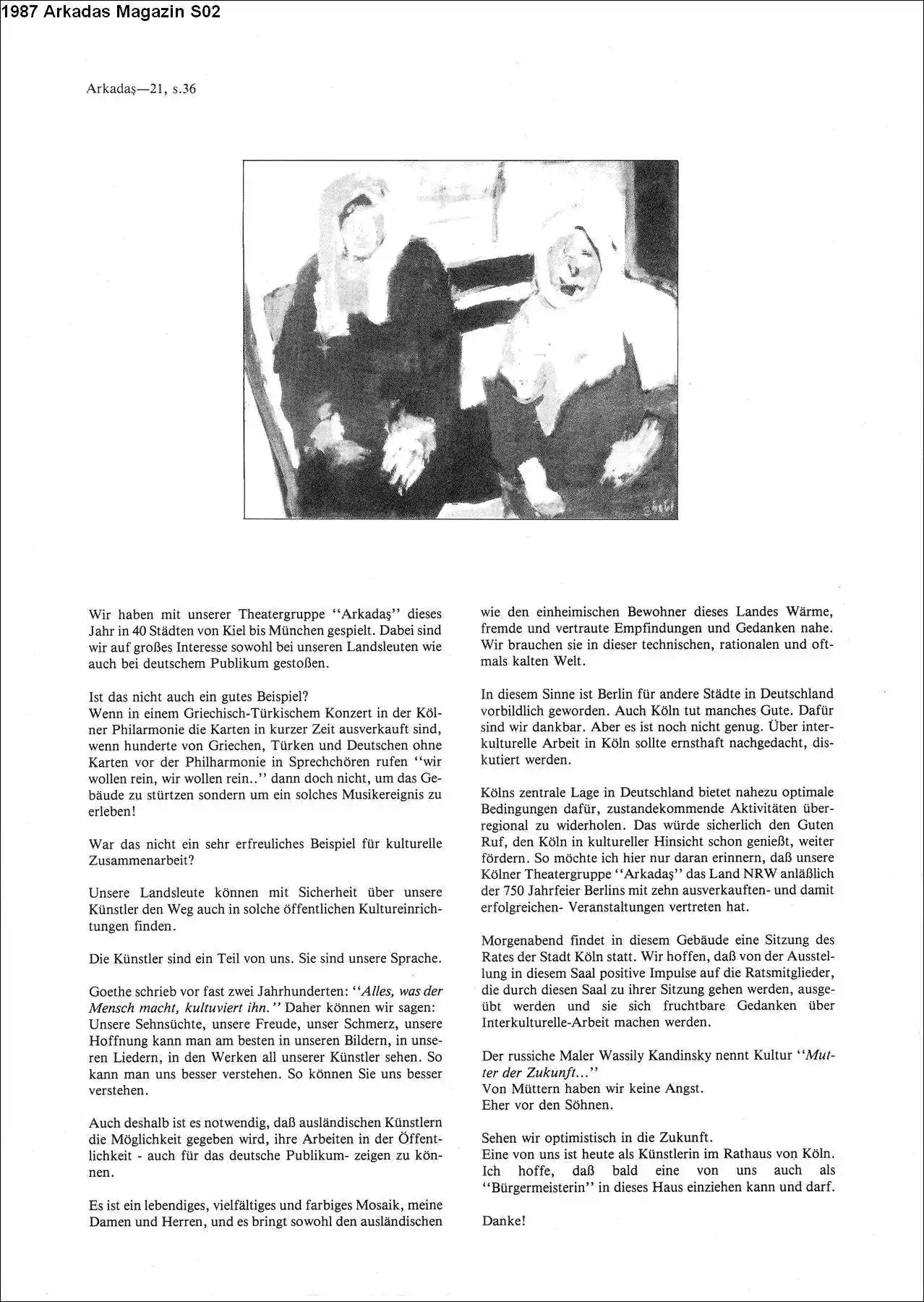
Her pictures, with their warm, glowing colors, were painted in dark rooms. But they were created in her bright, lively, warm-hearted inner world, which the dark confinement and heaviness of her living and working conditions could hardly impair.
I have spoken about this – especially about this – because Gönül’s life mirrors that of almost all artists who came here from Turkey. There are by now hundreds of writers, painters, musicians, and also those growing up here as artists of the so-called second generation.
Many of these artists have no home. Many are trying to survive. Many of them are not even here voluntarily; they had to come because their work was too “hot”, too dangerous for those in power.
From the other so-called recruitment countries, too, many artists came to Germany together with the workers. They came from Greece, Spain, Portugal, Italy and Yugoslavia.
Not to forget the hundreds of asylum seekers from all parts of the world.
Ladies and gentlemen, what a wonderful mosaic in the middle of Germany! What a great opportunity for Germany. This opportunity should absolutely be used – not only, but also, for so-called “integration”!
1.5 million people from Turkey live here. It would be regrettable if they could take part almost exclusively in the working life of this country, but not in its cultural or political life.
It is a prejudice to claim that foreigners have little or no interest in culture. Their different way of life is already part of another culture. This evening is the best example.
This year, with our theater group “Arkadaş”, we performed in 40 cities from Kiel to Munich. We met with great interest, both among our compatriots and among German audiences.
Isn’t that a good example too? When the tickets for a Greek-Turkish concert at the Cologne Philharmonie sell out in a short time, when hundreds of Greeks, Turks and Germans without tickets chant in front of the Philharmonie, “We want in, we want in…”, it is surely not to bring the building down but to experience such a musical event!
Wasn’t that a very gratifying example of cultural cooperation?
Through our artists, our compatriots can certainly find their way into such public cultural institutions as well.
Artists are a part of us. They are our language.
Goethe wrote almost two centuries ago: “Everything a person does cultivates them.” So we can say: our longings, our joy, our pain, our hope can best be seen in our pictures, in our songs, in the works of all our artists. That is how we can be better understood. That is how you can understand us better.
This is another reason why foreign artists must be given the opportunity to show their work in public – including to German audiences.
It is a lively, diverse and colorful mosaic, ladies and gentlemen, and it brings warmth, unfamiliar and familiar feelings and thoughts closer to both the foreign and the native inhabitants of this country. We need them in this technical, rational and often cold world.
In this sense, Berlin has become a model for other cities in Germany. Cologne, too, does a lot of good. We are grateful for that. But it is not yet enough. Intercultural work in Cologne should be seriously considered and discussed.
Cologne’s central location in Germany offers almost ideal conditions for repeating such activities beyond the region. That would surely further enhance the good reputation Cologne already enjoys in cultural matters. Let me just recall that our Cologne theater group “Arkadaş” represented the state of North Rhine-Westphalia at Berlin’s 750th anniversary celebrations with ten sold-out – and therefore successful – performances.
Tomorrow evening, a meeting of the Cologne City Council will take place in this building. We hope that the exhibition in this hall will give positive impulses to the council members who walk through it on their way to the meeting, and that they will give fruitful thought to intercultural work.
The Russian painter Wassily Kandinsky calls culture “the mother of the future…”
We are not afraid of mothers.
Rather of the sons.
Let us look to the future with optimism.
Today one of us is in Cologne City Hall as an artist.
I hope that soon one of us may also move into this house as “mayor”.
Thank you!
The speech appeared in Arkadaş Magazin No. 21, pp. 35–36. Necati Şahin was the founder of Cologne’s Arkadaş Theater. Translated from the original German wording.
About the Exhibition
Exhibition 1987: Cologne City Hall – listed in the overview Exhibitions of Gönül Sen-Menzel.
More press coverage of this exhibition:
- “Lively Pictures from Colorful Everyday Life” · Exhibition Report · Kölnische Rundschau
- “Gönül Şen’s Painting Exhibition” · Exhibition Report · Türkiye Postası
- “Applause for Gönül Şen’s Works” · Exhibition Report · Hürriyet
- “Pictures by the Painter Gönül Sen” · Short Review · Source unknown


