

“Hızın Resmini Yapıyorum” – Interview with the Painter Gönül Şen
Interview by Ömer Polat and Hasan Taşkale

Read the German original ↗
This article was published in German. The original text opens in a new tab in the German section of this website.
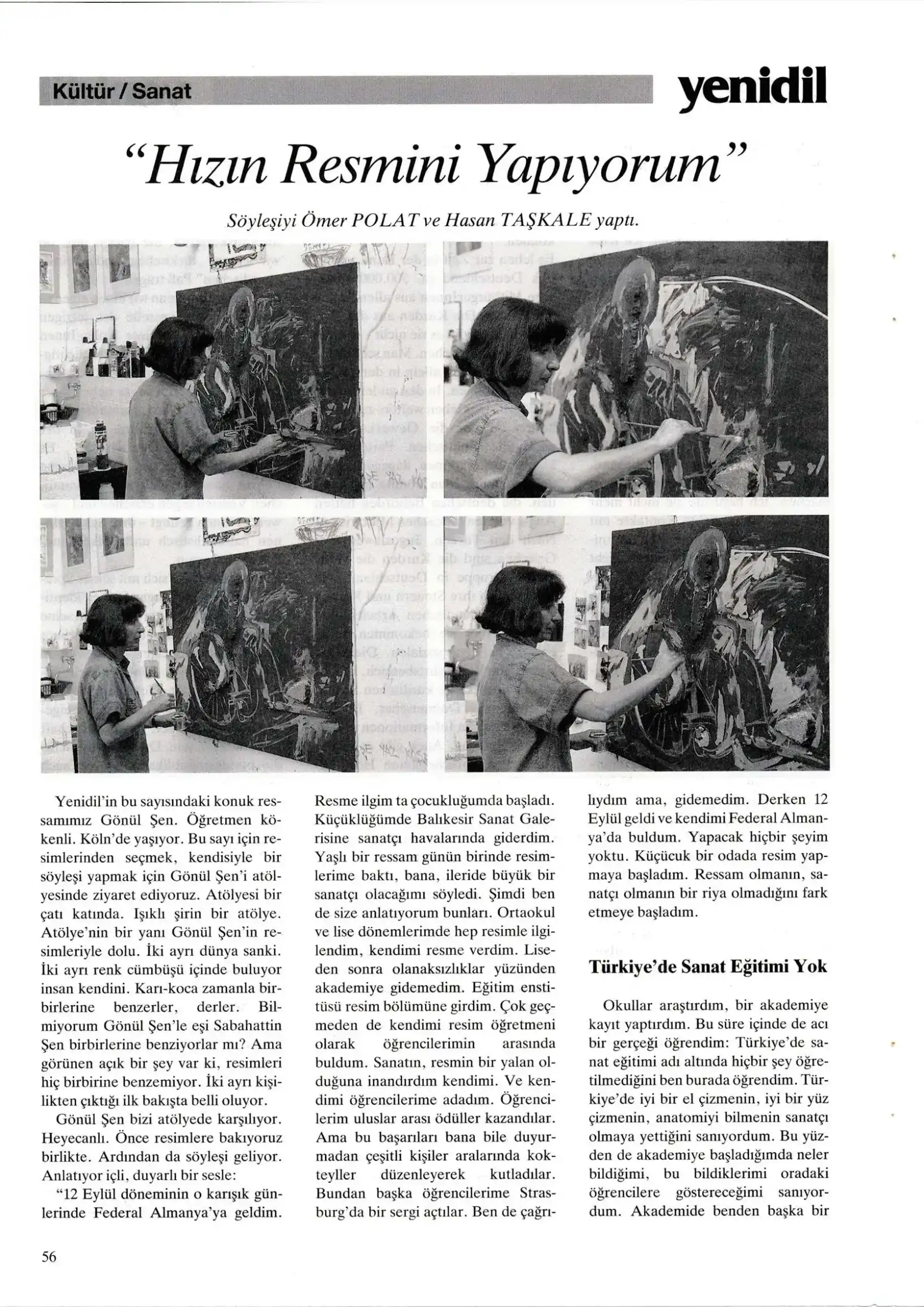
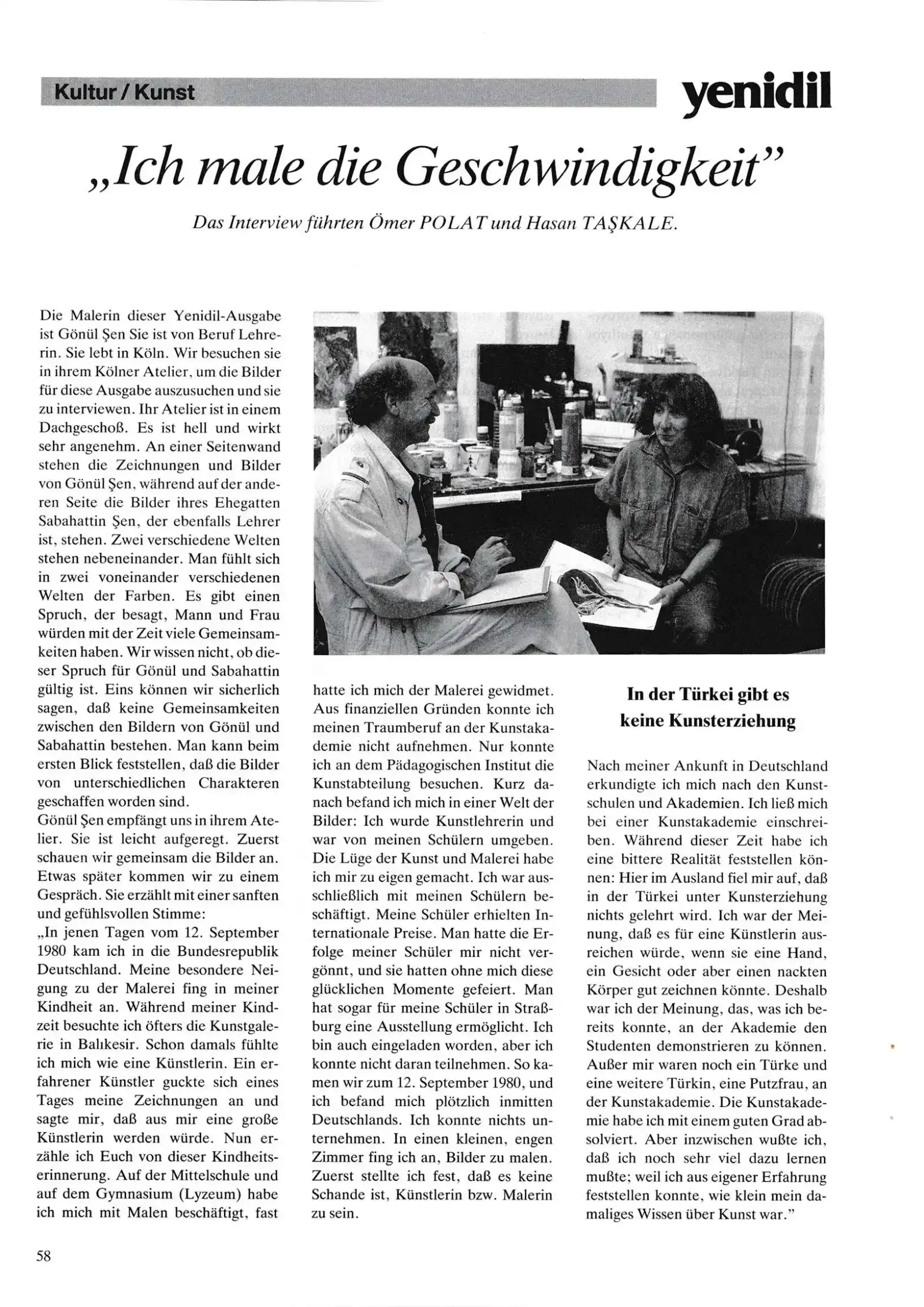
The painter featured in this issue of Yenidil is Gönül Şen. She is a teacher by profession. She lives in Cologne. We visit her in her Cologne studio to choose the pictures for this issue and to interview her. Her studio is in an attic. It is bright and feels very pleasant. Along one side wall stand Gönül Şen’s drawings and paintings, while on the other side stand the pictures of her husband Sabahattin Şen, who is also a teacher. Two different worlds stand side by side. You feel as if you are in two quite different worlds of color.
There is a saying that husband and wife come to have many things in common over time. We don’t know whether this saying applies to Gönül and Sabahattin. One thing we can certainly say: there is nothing in common between Gönül’s and Sabahattin’s pictures. At first glance you can see that the pictures were created by different personalities.
Gönül Şen welcomes us into her studio. She is a little excited. First we look at the pictures together. A little later we start talking. She speaks in a soft, emotional voice:
“I came to the Federal Republic of Germany in the days of September 12, 1980. My particular inclination toward painting began in my childhood. As a child I often visited the art gallery in Balıkesir. Even then I felt like an artist. One day an experienced artist looked at my drawings and told me I would become a great artist. Now I’m telling you about this childhood memory. In middle school and high school (lycée) I was busy painting; I had almost devoted myself to painting. For financial reasons I could not take up my dream profession at the art academy. I could only attend the art department of the Teachers’ Institute. Shortly afterwards I found myself in a world of pictures: I became an art teacher and was surrounded by my pupils. I made the ‘lie’ of art and painting my own. I was busy exclusively with my pupils. My pupils won international prizes. People begrudged me my pupils’ successes, and they celebrated these happy moments without me. An exhibition was even arranged for my pupils in Strasbourg. I was invited too, but I couldn’t take part. And so we came to September 12, 1980, and I suddenly found myself in the middle of Germany. I couldn’t do anything. In a small, cramped room I began to paint pictures. First of all I realized that there is no shame in being an artist or painter.”
There Is No Art Education in Turkey
“After arriving in Germany, I inquired about art schools and academies. I enrolled at an art academy. During this time I was able to see a bitter reality: here abroad I noticed that nothing is taught in Turkey under the name of art education. I had thought that it would be enough for an artist to be able to draw a hand, a face or a naked body well. So I thought I could demonstrate what I already knew to the students at the academy. Besides me, there was one Turkish man and one other Turkish woman, a cleaning lady, at the art academy. I graduated from the art academy with a good grade. But by then I knew that I still had a great deal to learn, because I could see from my own experience how small my knowledge of art had been back then.”
We interrupt her and take the floor again. We ask her what role, in her opinion, the Turkish-Islamic synthesis plays in art in Turkey. She smiles at us, makes a bitter face and continues:
“At the art academies in Turkey today, art students are currently taught gilding, Arabic and handicrafts. These are important things too, but they have nothing in common with an art academy! It is impossible to work with nude models. But Arabic is taught. I think an artist must be free. He should be able to paint his pictures in an unrestricted environment. But that no longer exists in Turkey today.”
We ask her whether she enjoys artistic freedom here abroad. She answers:
“It isn’t entirely easy here either. As long as a woman does not free herself from the dungeons of Islam, she cannot create free art. Especially when you live in a country as a foreigner and are still oppressed by your own community, it cannot be very easy. These thoughts finally gave me a new idea: to work with splendid colors. I enjoy the freedom of using color. In my pictures I use colors quite boldly and without inhibition. Whatever works as color, I use.”
Turkish Ink
We ask a question that interests us very much: “What is your invention in painting, or rather in colors?”
“When I was in Turkey last year, I felt bored. So I bought Turkish ink. Using this black ink, I discovered something special. Although the color was black, shortly afterwards it separated into blue, gray and brown. I was amazed. When I came back, I continued to use this ink for my work at the art academy. My friends were just as surprised as I was. Now they keep ordering Turkish ink from me. I tell them: ‘Buy your ink here, it’s even better!’ And they reply: ‘That’s exactly why it’s no use to us – we can’t find the same colors you found in the Turkish ink!’ That’s how our Turkish ink became famous.”
The interview continues. We hardly notice the time. Gönül tells us about the problems and difficulties of young artists in Turkey. She tells how young artists cannot afford to buy ink; how well-known artists keep the galleries occupied for themselves; how helplessly these young artists sit in the street without any support. As she talks about it, she dives back into her world of thought – we can read it in her face. It seems to us as if she is telling us about her past, in which she finds herself together with the young artists. We change the subject and ask about her latest works. Her eyes light up again, and she feels at ease:
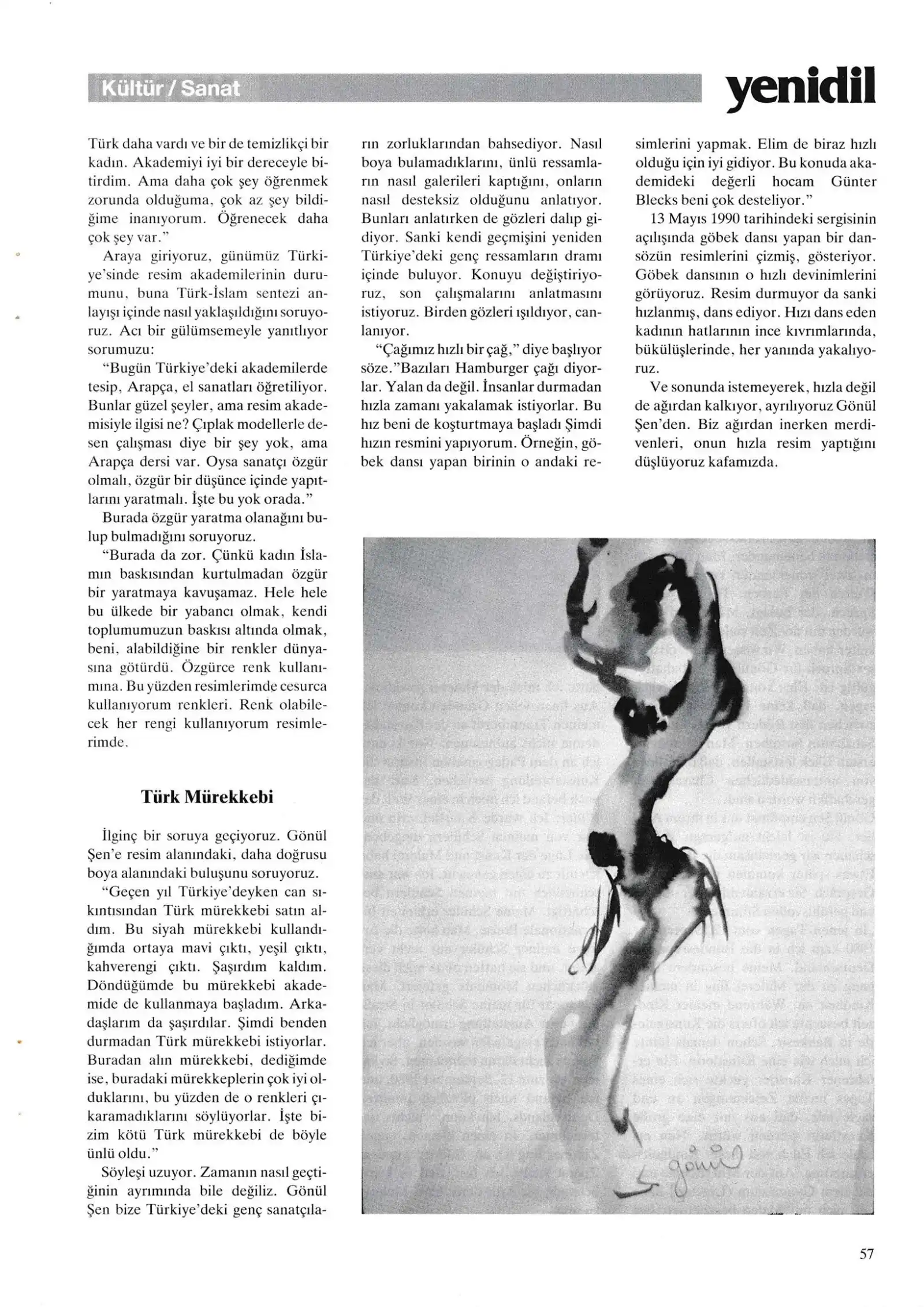
“Our age is very fast,” she says, and continues: “Some say our age is a hamburger age. That’s not entirely wrong. People want to catch up with time as quickly as possible. Speed occupies me too. Now I paint the pictures of this speed. For example, I paint or draw a belly dancer during her performance. I paint momentary pictures. Since my hands are also a bit nimble, I am satisfied with the results of my work. My professor at the art academy, Mr. Blecks, strongly supports my kind of pictures.”
She shows us the pictures from her exhibition on May 13, 1990, in which she captured the belly dancer in her works. We too see the movements of a belly dancer in the works she shows us. We have the impression that the pictures go on dancing. You can follow the dancer’s individual movements in these pictures.
We say goodbye to Gönül Şen. But not as quickly as her pictures showed us – quite leisurely and slowly. As we go down the stairs, we think of Gönül Şen at work. She is painting more fast movements.
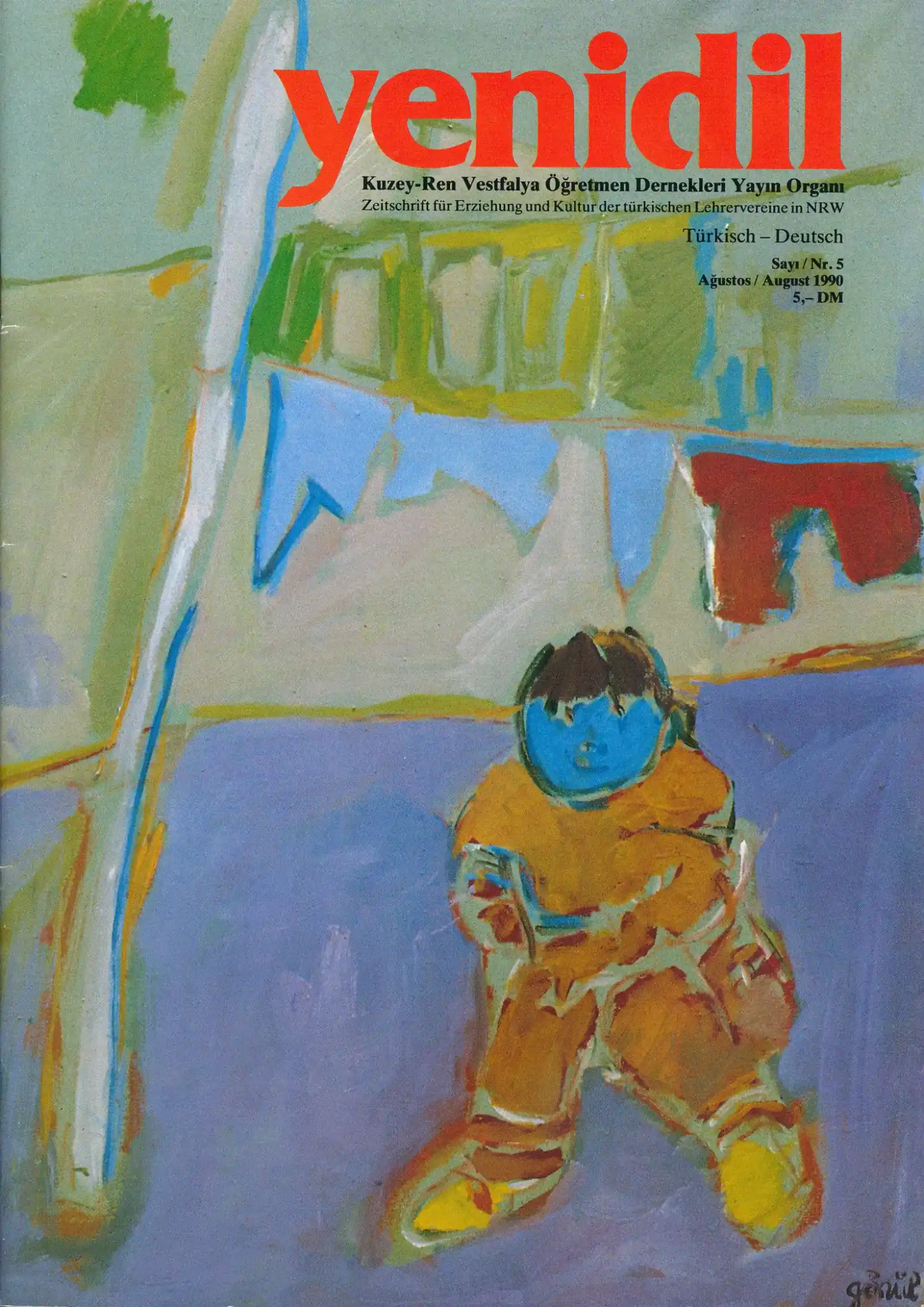
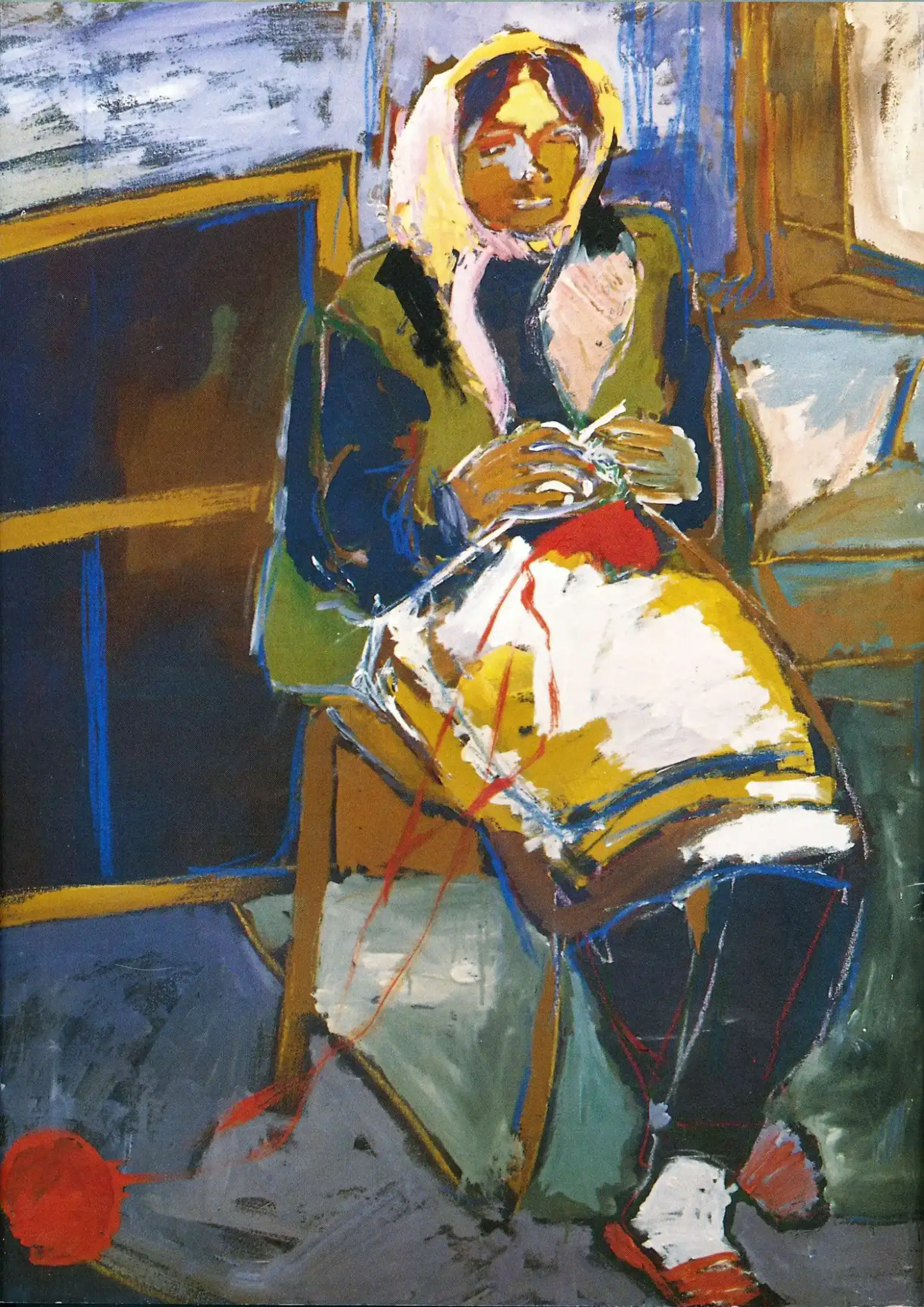
The interview appeared bilingually in the magazine Yenidil, August 1990: the Turkish version (“Hızın Resmini Yapıyorum”) on pages 3 and 4 of the images, the German version on pp. 58–59. This English translation is based on the German version printed in Yenidil. The first two images show the front and back covers of the issue.


