

Art Can Keep the Dream of Redemption Alive
By Anja Labussek
Read the German original ↗
This article was published in German. The original text opens in a new tab in the German section of this website.
Art and Church
Is presenting art solely the business of museums? Or can and should works of art also be part of Protestant worship? Regional pastor Dr. Rainer Sommer addressed these questions in a lecture at the Haus der Kirche on Bastionstraße. Sommer spoke on the topic “Theology for the Eyes” as part of the Stadtakademie series “Meaning and the Senses”.
The debate about art and church gained topical relevance from the Duisburger Akzente festival, which had just ended. As part of the overall program, a number of Protestant churches in Düsseldorf’s neighboring city temporarily exhibited works from the Lehmbruck Museum. Viewers – who were, after all, largely the Sunday churchgoers – saw a sculpture familiar from the museum anew in a different space, and discovered new dimensions in a work of art they knew from the museum.
Art and church, Sommer said, can certainly be combined, even though the Protestant church stands in a rather ascetic tradition when it comes to decorating churches. Art, according to the definition of the regional pastor for visiting services at the mission office of the Rhineland church, always presupposes a dissatisfaction with reality. Art is a form of interpreting the world and coping with existence. It is not meant to offer redemption itself, but to keep the dream of redemption alive.
Sommer presented a concept of liturgical art comprising three main points. While the word of God is revealed to the congregation in sermon and sacrament, the creation of works of art can be one possible response to it. The origin of liturgical art must therefore be recognizable in listening to the word and engaging with it, which may also happen critically, in the form of doubt. Since the response to the word is always the response of a community, such art must also include this community and be understandable to it. Finally, if art wants to be more than purely aesthetic and historical, it should not stand in isolation but be integrated into the course of worship.
The Rhineland “Advisory and Study Center for Worship” works to find ways of including art in worship. It has set up a discussion group of pastors and artists. Through dialogue with interested artists such as Günther Uecker or Norbert Kricke, the Rhineland church hopes to explore how visual art can be integrated into worship and given a permanent place there.
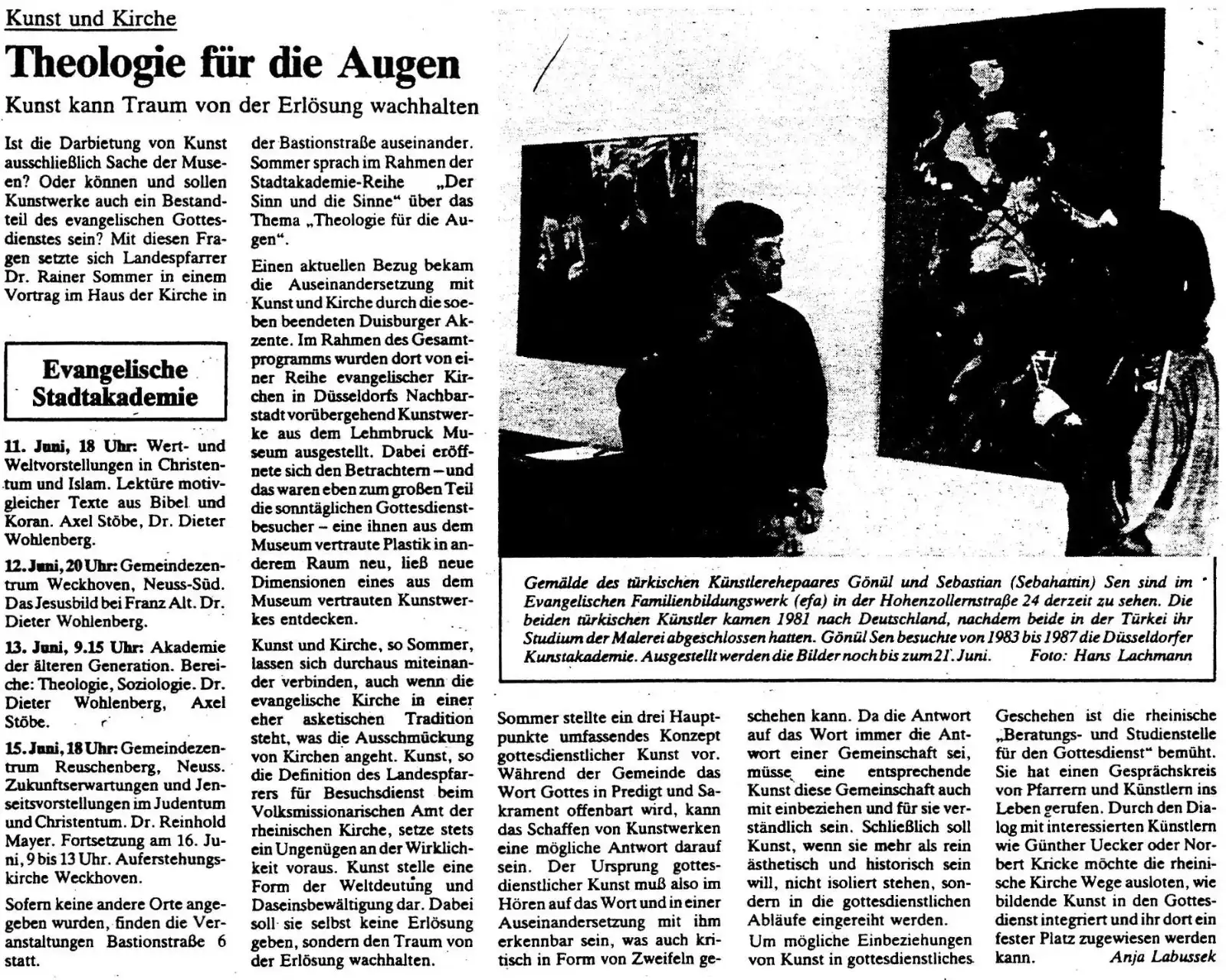
Photo caption: Paintings by the Turkish artist couple Gönül and Sebastian (Sabahattin) Sen are currently on view at the Evangelisches Familienbildungswerk (efa), Hohenzollernstraße 24. The two Turkish artists came to Germany in 1981, after both had completed their studies in painting in Turkey. Gönül Sen attended the Düsseldorf Art Academy from 1983 to 1987. The pictures are on display until June 21. Photo: Hans Lachmann
Evangelische Stadtakademie – Program
June 11, 6 p.m.: Values and worldviews in Christianity and Islam. Reading of texts with shared motifs from the Bible and the Quran. Axel Stöbe, Dr. Dieter Wohlenberg.
June 12, 8 p.m.: Weckhoven community center, Neuss-Süd. The image of Jesus in Franz Alt. Dr. Dieter Wohlenberg.
June 13, 9:15 a.m.: Academy of the Older Generation. Fields: theology, sociology. Dr. Dieter Wohlenberg, Axel Stöbe.
June 15, 6 p.m.: Reuschenberg community center, Neuss. Expectations of the future and ideas of the afterlife in Judaism and Christianity. Dr. Reinhold Mayer. Continued on June 16, 9 a.m. to 1 p.m., Church of the Resurrection, Weckhoven.
Unless another location is given, events take place at Bastionstraße 6.
The article appeared in 1991 in a Rhineland daily newspaper (section “Art and Church”); the newspaper and exact date are not given on the clipping. Gönül Sen-Menzel is mentioned in the photo caption about the exhibition at the Evangelisches Familienbildungswerk.


